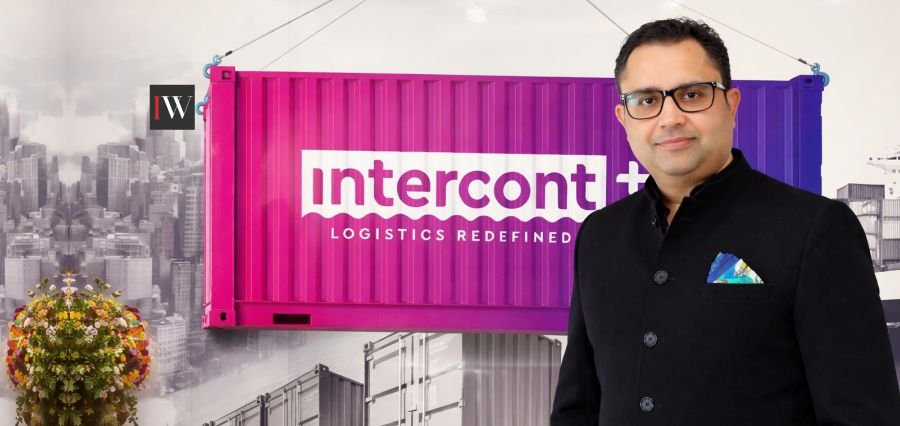
In an industry where speed, accuracy and consistency are the key attributes of successful performance, the most influential changes are seldom made at the port or the warehouse. They occur when a company is bold enough to raise a more challenging question, not how to ship more cargo, but how to shift an entire industry. It’s exactly the question that Intercont+ is inquiring.
Having a solid presence in temperature-controlled logistics and being able to process more than 70,000 TEUs per annum over major trade routes around the world, like Southeast Asia, GCC, ISC, Europe, and Africa, the firm has now established itself as an industry leader and trusted player.
Nevertheless, it is not only its size that can be seen as the new characteristic of the company today, as it is determined by its desire to reshape the way logistics companies conduct business in a blisteringly dynamic world. The emphasis has moved to the conventional growth measures to establish a technology-equipped, process-driven and performance-oriented organisation in keeping with the clear and ambitious Vision 2030 road map.
This change represents more of a philosophical change in the organization, to cease being a relationship-based, trust-based, execution-based business and to become a systematic organisation, full of data and accountability. The company, under the leadership of Managing Director & CEO Gaurav Sethi, is in the process of entrenching clarity of vision, discipline in the execution process and empowerment within teams, ensuring that growth is not pegged on individuals but through robust organizational systems.
Building beyond movement
Intercont+ stands on a 40-year foundation built on handshakes, hard work, and hard-won relationships. Today, it operates across major global trade corridors, Southeast Asia, GCC, ISC, Europe, and Africa, with a commanding presence in temperature-controlled logistics. Yet the company is navigating a defining inflection point: one where scale alone no longer measures ambition, and where the real work lies in building an organization that is process-driven, technology-led, and built to endure.
The story of Intercont+ today is not simply a story of cargo moved or milestones met. It is the story of a company consciously outgrowing its own origin, transforming from a relationship-dependent enterprise into a scalable, institutionalized platform for global trade.
A Legacy Reimagined
Gaurav did not arrive at leadership through a conventional corporate path. He grew up watching founder Mr. Gopal Sethi build Intercont from the ground up, absorbing by osmosis the values that give the business its spine: resilience, relationships, and reputation. Those formative years gave him a fluency in logistics that no classroom could replicate an instinctive understanding of how freight moves, how trust is earned, and how thin the margins for error can be when timing governs everything.
They also gave him a clear-eyed view of what the next chapter would demand. What built the company would not be sufficient to scale it. The first phase of growth ran on trust and execution excellence qualities that remain essential and that the company is careful not to discard. But the next phase calls for something more structural: scalability, strategic clarity, and systems that carry the company’s intent even when its founders are not in the room.
As Gaurav frames it, “Legacy gives you a foundation, not a direction.” That realization has become the animating force behind everything Intercont+ is building today.
Scaling with Structure
At 70,000+ TEUs annually, Intercont+ has grown beyond the reach of personality-driven management. The company has reorganized its leadership approach around three core pillars: clarity of vision aligned with a defined 2030 roadmap; accountability in execution through structured KRAs and KPIs across all levels; and empowerment through teams that make decisions independently rather than waiting for direction from the top.
This is a deliberate pivot from a relationship-led enterprise to a process-driven, performance-oriented organization. As the company expanded, it invested in internal governance frameworks, audit systems, and process standardization not to add bureaucracy, but to reduce leakages, improve efficiency, and ensure that decision-making authority sits at the right level. The operating principle is precise: “Complex businesses don’t need more complexity, they need simpler rules.”
Resilience by Design
Cold chain logistics is an unforgiving business. Intercont+ handles perishable commodities, such as fruits, vegetables, meat, and seafood, where a delayed shipment does not translate to a dissatisfied customer alone; it translates to direct, irreversible commercial loss. The company manages premium freight movements that at times exceed USD 5,000–6,000 per container, across trade environments shaped by port diversions, geopolitical tensions, and volatile global supply chains.
To operate with confidence in that environment, the company has made resilience a structural feature rather than a reactive instinct. The company deploys strong SOP-driven execution frameworks, maintains deep relationships with global carriers and partners, and increasingly leverages data and analytics to improve real-time decision-making.
Contingency is engineered into the operating model. Teams are trained not just to follow processes in normal conditions, but to navigate intelligently when conditions shift without waiting for instructions that may not arrive quickly enough. “Efficiency gets you through stable times. Resilience is what sustains you through disruption.”
Culture as Strategy
One of the more significant transformations underway at Intercont+ is cultural. The company is not treating culture as an ambient quality shaped by tenure and habit. It is treating it as a deliberate strategy, one that must be actively designed, consistently reinforced, and periodically stress-tested against growth ambitions.
This organization is actively transitioning toward a merit-based, performance-driven model where ownership is clearly defined, accountability is visible, and outcomes are measured and rewarded. Structured performance management systems are being introduced, and teams are being aligned more directly with business outcomes. Roles are no longer defined by seniority alone; they are defined by contribution and the ability to own a problem and drive it to resolution.
Simultaneously, the company is bringing in younger, growth-oriented talent while making the difficult decisions that organizational transformation demands, including parting ways with those whose working styles no longer align with its direction. The conviction is clear: “Good is the enemy of great, and great organizations are built by people who are willing to stretch beyond comfort.”
The Technology Imperative: Project NOVA
The logistics industry is undergoing rapid transformation driven by digitization, shifting customer expectations, and the reconfiguration of global trade flows. Intercont+’s response to this transformation is not reactive adaptation; it is proactive investment. At the centre of that investment is Project NOVA, the company’s AI-led transformation initiative.
The company does not position AI as a branding exercise. It treats it as a decision-enabling layer that improves efficiency, predictability, and collaboration across the business. Combined with a strategy to deepen its presence across imports, exports, and cross-trade opportunities, and a clear intent to explore strategic acquisitions, the company is assembling the capabilities of a genuinely global logistics platform. The approach is deliberately long-term: building systems that enable fast decisions without losing strategic direction. “The key is to make change a continuous process, not a one-time initiative.”
Standing With Customers When It Counts
No account of Intercont+’s evolution is complete without acknowledging the moments that have tested it most. Managing large-scale disruptions port diversions, geopolitical flashpoints, and cascading supply chain failures has been among the defining tests for the organization. In situations where cargo was delayed, costs escalated significantly, and customer expectations remained high, the company’s response came down to three non-negotiables: transparency, ownership, and action.
There were no comfortable options, no easy explanations. What the moment demanded was presence, a willingness to absorb difficulty alongside the customer rather than simply report it. “Our role is not just to move cargo, but to stand with our customers, especially when things don’t go as planned.”
Those crises have not weakened Intercont+’s relationships; they have deepened them, forging the kind of trust that no sales pitch can manufacture. They have also strengthened internal capabilities: the communication protocols, escalation frameworks, and cross-functional problem-solving muscle that the company will need as it scales into new geographies and markets.
Built to Outlast
Intercont+ is not building for the next quarter. It is built for the next generation. The 2030 roadmap charts a path toward significant revenue growth, margin improvement through value-added services, international expansion across key trade corridors, and inorganic growth through mergers and acquisitions.
What distinguishes this vision is the accompanying ambition to build an organization that is institutionalized, process-driven, and not dependent on any single individual, a company that performs because of its systems, its culture, and its people.
The legacy being built is precise and purposeful: “A company that is built to last, driven by people, powered by systems, and guided by purpose.”
It is no longer simply a logistics company. It is becoming an institution, one that carries the weight of a 40-year legacy forward into a future shaped by technology, global trade, and the kind of enduring accountability that turns enterprises into legacies worth inheriting.
By that measure, the firm is an intentional institution in the making. Every strategic decision being made today, the redesign of performance systems, the investment in AI through Project NOVA, the cultivation of young talent, the pursuit of global growth traces back to the same governing belief: that great organizations are not built by individuals alone, but with people, and sustained by the systems those people operate within.
As it embarks on its next chapter, it carries the energy that has chosen transformation over comfort. As the 1,000-crore revenue milestone comes into view, as Project NOVA’s technology roadmap takes shape, and as the company’s global footprint widens, this firm is no longer simply competing in the logistics industry. It is redefining what a sustainable, future-ready logistics company ought to look like. And at the heart of that redefinition is a clear and enduring conviction: that the most important cargo any business carries forward is its purpose.