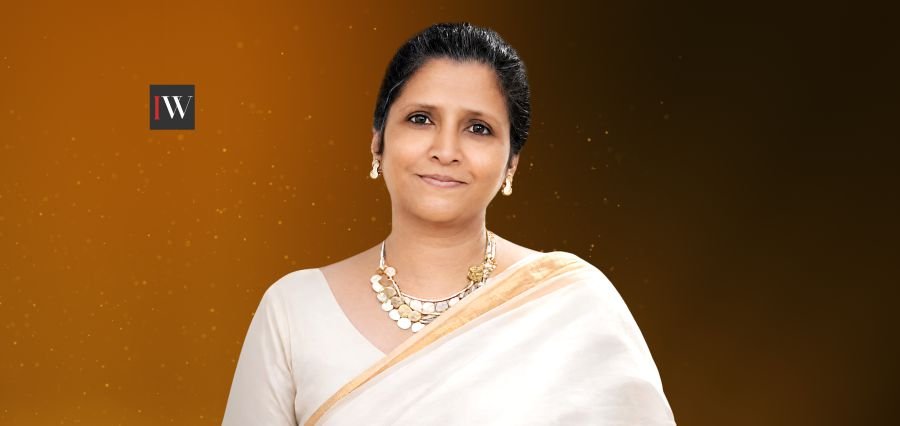
In times when businesses are striving to digitize, automate and optimize, and where algorithms analyze applications and dashboards track employees’ morale, Treesa Bizira reminds us that, regardless of all these advances, the most powerful element in any business is inherently human. As a CXO-level HR professional with more than a decade of experience in multinational companies, start-ups, and crucial organizational turnarounds, she possesses a vision which is both disarmingly straightforward and exceedingly rare, that human resources ultimately boil down to ethics.
Her career did not start in any corporate office; rather, it started in the corridors of Lucent Technologies, wherein she worked in the Dolphin network, a wireless MTNL-based network, where her mentor, Gary Gearheart, British expat ( ex army), saw something in her that she herself had not recognized yet. She was committed, and he could see her knack for people, precision, sense of intuition , and motivated her to do what needed to be done. She pursued her education through NMIMS along with working, an act facilitated also by a colleague of hers named Kaustubh, who lent her the fees of studies on an instalment basis. This is something she does not forget to mention, and the very fact of mentioning speaks a lot about her character as a leader.
“HR for me is ethics and standing for what is right,” she states
That sense of integrity, the instinct to acknowledge those who helped along the way, is the thread that runs through every chapter of Treesa’s career. Her experience covers every aspect of human resources from hiring and managing performance to compensation, education, engagement, and even ESG. As she holds a diploma in Forensic Science and Criminal Law, she is currently pursuing her LLB from MKLM and has been deployed as a member of an International Incident Response Team.
Consistency in her personality is another thing for which she was appreciated by her employers more than once. Praise in town hall gatherings, recognition at the Lucent Dolphin project, and gratitude expressed by her mentees speak for Treesa’s dedication and commitment to her career path.
Leading From Within: Culture Before Strategy
When Treesa assumes responsibility in any new organisation, she does not arrive with a predetermined playbook. She arrives with patience. Her approach to driving culture and organisational growth begins with deliberate observation soaking in the existing culture, decoding the strategy, and reading the personalities around her. Only then does she begin to manoeuvre.
She is direct about one structural truth that many organisations resist: change travels top to bottom, never in reverse. Leaders who preach transformation while refusing to model it are, in her view, wholly ineffective. The most credible leaders do not merely speak change into existence they enact it visibly, consistently, and without exception.
“Leaders of today should pave the way not by talk but by action. You are handling people — to drive organisational growth and culture, you need to be a part of them, allow them to trust, and help them grow,” she states
Inclusivity and diversity, she notes, are not programmes to be launched; they are postures to be embodied. Over the course of her career, she has worked alongside colleagues from backgrounds spanning continents and cultures, and she has never made it a matter of distinction.
For her, the way one communicates with people beyond the formal register, outside the hierarchy, beyond the reporting lines, defines far more about a leader’s character than any policy document ever could. Her guiding principle in this regard is characteristically unambiguous: be yourself, on and off the clock. A façade, she argues, is always detected and always costly.
The Art of Talent: Intuition Backed by Evidence
Among the many domains of HR, Treesa identifies talent acquisition and performance management as her two primary fortes. She speaks about both with a quiet confidence that comes not from arrogance but from a track record she has repeatedly validated. Her instinct for cultural fit, her ability to assess whether an individual will thrive within a specific organisational ecosystem and has, in her own reckoning, been consistently accurate.
One instance she recounts involves her earlier tenure at CMA CGM. A candidate from Sri Lanka was shortlisted for a mid-level position. He was shy, understated, and failed to project the confidence the hiring panel sought. No one backed him. She stood her ground. Today, that individual performs with remarkable distinction, both for himself and for the organization a quiet validation she neither boasts about nor dismisses.
Her approach to performance management is equally shaped by proximity and observation. She keeps her ear to the ground, watches quietly, and delivers recommendations that carry the weight of evidence gathered over time. It is a practice rooted in the same principle that guides all her HR philosophy: people deserve to be seen accurately, not merely measured efficiently.
Redefining the Future: AI, Hybrid Work and the Human Constant
The post-pandemic transformation of the workplace has accelerated every tension in the HR function between flexibility and accountability, between digital efficiency and human connection, between the promise of artificial intelligence and the irreplaceable nature of human judgment. Treesa navigates this terrain with characteristic nuance.
She acknowledges that AI-assisted interviewing and hybrid working models are now foundational realities, not experiments. She has worked with start-ups where culture is built gradually and incrementally, where the adoption of new working models requires sustained persuasion. But she is also unambiguous about the limits of technology as a leadership substitute.
“aI with human intervention will always make a difference. I have, in purpose, kept the ‘a’ in aI small — because ‘artificial’ is secondary; it is ‘Intelligence’ that precedes,” she asserts
Her point is both philosophical and practical. Micromanagement, she asserts, is wholly incompatible with the expectations of today’s workforce. Employees at every level want to be treated as contributors, trusted, respected, and encouraged, not monitored. The organizations that understand this distinction attract and retain talent. The organisations that do not lose it to attrition never fully comprehend.
Wellbeing As a Leadership Commitment
Treesa’s personal approach to wellbeing is not a policy: it is a practice she models daily. Sports and fitness have been constants in her life. Learning, reading, and writing have remained ongoing pursuits. She carries an appetite for growth that she actively channels into her teams, encouraging colleagues to pursue education, take ownership of their physical and mental health, and find meaning in the work beyond the immediate task.
Her HR cabin has earned a name: the Escape Room. It is a space where colleagues are invited to speak freely about anything, with the assurance that nothing leaves unless it needs to. It is a small but telling detail about the kind of leader she is, the one who understands that the most important conversations in any organisation are often the ones that happen quietly, between one person and the one HR leader they trust.
Beyond the corporate perimeter, she contributes to causes for the underprivileged, supports vocational and educational initiatives for women in prison, and has served as a member of a Distress and Crisis Management team in Ethiopia. She is also a member of an International Incident Response Teams and holds a diploma in Forensic Science and Criminal Law, alongside a currently pursued LLB from MKLM. During the pandemic, she performed final rites for individuals, including the washing of the deceased. It is an act that defies easy categorisation, except as evidence of someone for whom human dignity is not a talking point but a lived value.
A Message To The Next Generation
When Treesa speaks to aspiring HR professionals, her counsel is characteristically concise. She urges them to hire for attitude as much as aptitude, to embrace flexibility and innovation, to simplify rather than complicate, and to seek solutions rather than assign blame. But her final instruction is delivered with unmistakable weight which reveals the most about who she is.
“Stand up for what is right, even if it seems you are alone.”
It is the kind of advice that only someone who has lived it can give with genuine conviction. Across every organization that she has served and every individual she has championed, done exactly that. As India’s corporate landscape continues to evolve- shaped by AI, disrupted by hybrid realities, tested by an increasingly mobile and vocal workforce, leaders of her calibre are not merely valuable. They are essential.
Along with this, she also emphasizes on qualities like:
- Be You.
- Hire not only aptitude but attitude that caters to the development of every Individual.
- Flexibility and Innovation at work is the key.
- Make life simple.
- Always try to find a solution not search who created the problem.
For HR professionals in India, an important juncture has been reached. The automated is taking away at the transactional. The accelerated power of AI is taking over from the analytical. What is left, what cannot be touched and tampered with, is the inherently human aspect, where judgment calls must be made, and conversations need to be had, often alone in a room, because sometimes that is the only thing integrity will allow. This cannot be taught to a computer program. It needs to be lived out in a human being.
This is who Treesa Bizira is, this individual who has devoted herself to various organizations and causes through the course of her career. She is, in every way possible, an architect of human potential, and the construction is far from over.